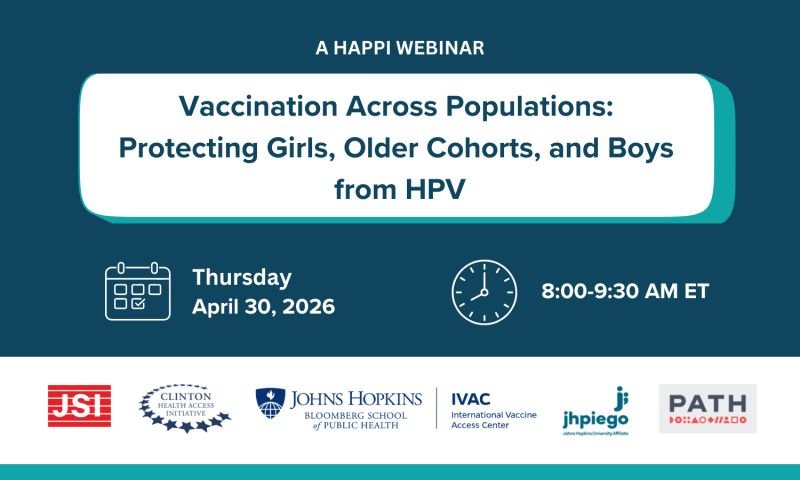
The global HPV vaccination landscape has shifted from a period of scarcity to one of strategic opportunity. While girls aged 9–14 remain the global priority, achieving high coverage requires moving beyond a "one-size-fits-all" model to address the deep diversity within and across groups. First, ensuring that all girls are reached, including those out-of-school or in marginalized communities, demands local, contextual adaptations rooted in the lived experiences of the users themselves. As countries stabilize these core programs, they face a new strategic horizon: the inclusion of "secondary" populations, namely older girls and boys. Expanding these cohorts is not merely a matter of increasing supply; it requires navigating political and cultural landscapes, resource shifts, and delivery adaptations to fully address the needs of each population group.
This webinar explores learnings across the programmatic spectrum, from user-centric insights to national-scale implementation. We begin with a deep dive into a Human-Centered Design (HCD) study that elevates and centers the voices of girls as primary users. Building on this foundation, we present studies focused on "secondary" populations: a review of reaching older girls and expanding to Gender-Neutral Vaccination in low-and-middle-income countries. The session culminates in a high-level panel of country representatives who will share practical programmatic adaptations for each of these three distinct groups. Participants will walk away with a nuanced understanding of how to maintain a girl-centered core while successfully navigating the logistical and political shifts necessary for a truly inclusive HPV vaccine program.